← Back

fish.logged

Species guide

Smoothhound

Mustelus mustelus

How to identify Humane dispatch & preparation What to eat

01

How to identify

Full guide →

What you're looking at

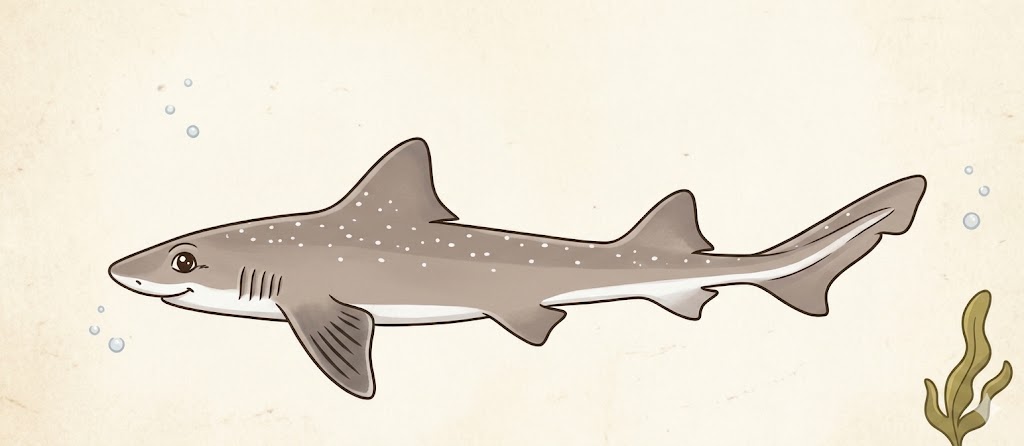
The smooth hound (Mustelus mustelus) is a small coastal shark with a slender, streamlined body. It is not to be confused with the starry smooth hound (Mustelus asterias), which is covered in white spots. The plain smooth hound has an unmarked grey-brown back fading to a pale white belly.

Key features

  • Body: Slender and shark-like, tapering to a forked tail. Typically 60–120 cm, up to 150 cm in large females.
  • Dorsal fins: Two dorsal fins, neither has a spine, a key difference from dogfish species.
  • Snout: Moderately long and pointed. The underside of the snout has small sensory pores (ampullae of Lorenzini).
  • Eyes: Oval with a horizontal cat-like pupil. Nictitating membrane (inner eyelid) visible when touched.
  • Teeth: Small, flat, and pavement-like, adapted for crushing crabs and lobsters, not cutting. Safe to handle the open mouth.
  • Gill slits: Five on each side, just ahead of the pectoral fins.
  • Colour: Plain grey or brownish-grey above, white below. No spots.

Confusion species

  • Starry smooth hound: Looks identical but has white spots scattered across the back. Both species often school together.
  • Tope (Galeorhinus galeus): Much larger (up to 180 cm), pointed first dorsal fin, notched upper caudal lobe. Lacks the flat crushing teeth.
  • Lesser spotted dogfish: Obvious spots, rough sandpaper skin, much smaller. First dorsal fin originates well behind the pelvic fins.

Where to find them

Smooth hounds favour sandy and mixed ground, particularly around shellfish beds in estuaries and inshore bays. They are most active at night and during flood tides. Common from late spring to early autumn around the UK coastline. Frequently caught from beaches and marks with access to sandbanks.

02

Humane dispatch & preparation

Full guide →

Should you keep one?

The smooth hound is currently not under a formal bag limit in the UK, but stocks are considered vulnerable. Consider keeping only one or two fish per session, and return any females (which are larger and breed later in life). The starry smooth hound is subject to a recommended minimum size of 50 cm total length by the NFSA.

Humane dispatch

Sharks should be dispatched quickly and with minimum stress. The preferred method is iki jime.

  • Lay the fish flat and keep it still, a wet cloth over the eyes calms them.
  • Locate the brain: on a smooth hound it sits just behind the eyes, roughly level with the tops of the gill slits. Feel for a soft spot at the rear of the skull.
  • Drive a sharp spike (iki jime spike, marlinspike, or thick wire) firmly into the brain in one motion. The fish should go limp instantly with a brief muscular shudder.
  • If you do not have a spike, a firm, sharp blow to the top of the head with a priest directly above the eyes is an acceptable alternative.

Bleeding

Bleeding improves the quality of the flesh significantly and removes the urea-based ammonia smell common to all sharks.

  • Immediately after dispatch, cut the gills on both sides or make a deep cut at the base of the tail where the caudal fin meets the body.
  • Hold the fish head-down over the water or a bucket for two to three minutes.
  • Place straight into an ice slurry. Cold slows the urea conversion that causes the ammonia smell.

Skinning

Smooth hound skin is covered in tiny dermal denticles (placoid scales) that feel like coarse sandpaper. The skin is edible but tough; most people remove it.

  • Make a shallow cut around the circumference just behind the head.
  • Use pliers and a cloth to grip the skin and pull firmly toward the tail, it peels back in one piece on fresh fish.
  • Alternatively, skin the fillets after they have been cut from the carcass, holding each fillet skin-down and running the knife between skin and flesh.

Gutting

  • Make a shallow incision from the vent (cloaca) forward to the base of the pectoral fins, keep the cut shallow to avoid puncturing the digestive tract.
  • Remove the stomach, intestines, and liver. The liver is edible and rich in oil.
  • The spiral-valve intestine is distinctive and compact; remove it whole.
  • Rinse the body cavity thoroughly with cold seawater.

Dealing with the ammonia smell

All cartilaginous fish (sharks, skates, rays) store urea in their flesh. If the smell is present after bleeding and chilling, soak the fillets in cold salted water or milk for 30–60 minutes before cooking. This draws out the remaining urea and leaves clean, mild flesh.

03

What to eat

Full guide →

The flesh

Smooth hound has firm, dense, white-to-pale pink flesh with no pin bones, the skeleton is cartilage, not true bone. The texture holds together well under heat and does not flake apart like white fish, making it forgiving to cook. Properly prepared (bled and chilled immediately), the flavour is mild and clean with a slight sweetness.

It has long been sold in UK fish and chip shops as rock salmon or rock eel: the same name covers tope and other small sharks. If you have eaten rock from a chippy, you have likely eaten smooth hound.

Which parts to eat

  • Fillets: The main eating. Two thick loins run either side of the cartilaginous spine. Boneless once the central cartilage is removed. Yield is high relative to body weight.
  • Cheeks: On larger fish, small nuggets of dense flesh sit either side of the lower jaw. Worth keeping.
  • Liver: Rich and oily. Can be used in pâté or pan-fried. Strong flavour, an acquired taste.
  • Fins: Not worth eating in UK species. The fin-drying practice associated with the shark fin trade does not apply to smooth hounds caught for table use.

How to cook it

  • Battered and fried: The classic. A tempura or beer batter works especially well, the dense flesh holds up where cod would fall apart.
  • Grilled: Brush with oil, season well, and grill on high heat for 3–4 minutes per side. It colours well and stays moist.
  • Baked: Wrap a loin in foil with butter, lemon, capers, and herbs. 180 °C for 20 minutes.
  • Curried: The firm texture handles long cooking in a sauce. Works particularly well in a coconut milk-based curry.
  • Goujons: Cut into thick strips, breadcrumb, and shallow-fry. One of the best ways to serve it.

Flavour pairings

Lemon, capers, tartare sauce, brown butter, garlic, chilli, ginger, coconut, smoked paprika. The mild flesh takes bold seasoning well without being overwhelmed.

Storage

Use within 24 hours if fresh, or freeze immediately after filleting. Freezing actually helps reduce any residual ammonia smell by further breaking down the urea. Defrost slowly in the fridge and cook from cold.

Track your catches

Log every Smoothhound you land.

Start logging free →

Already have an account? Sign in